


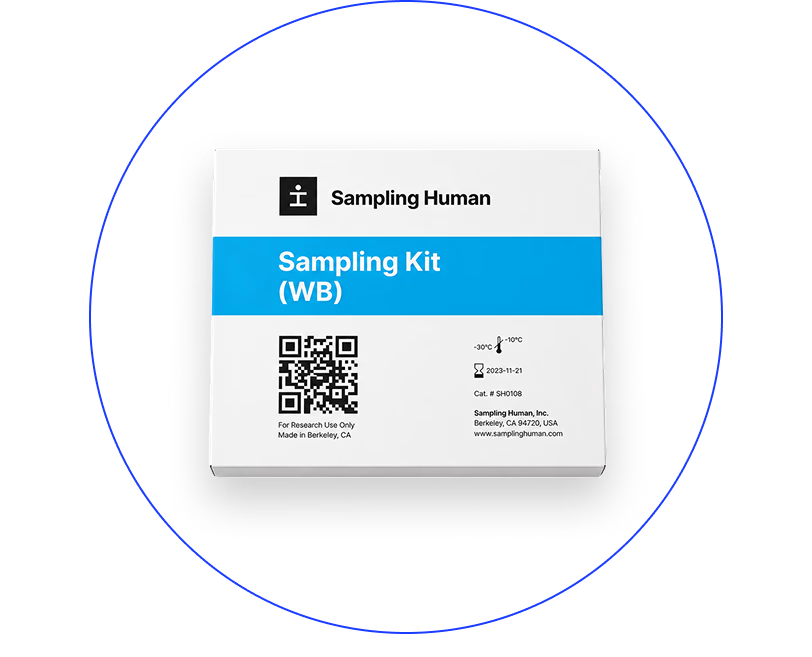



Integrated end-to-end for operational performance
Our workflows run inside automated molecular lab infrastructure, integrating optimized sample collection, proprietary encoding chemistry, decoding models, and quality control to make cellular-resolution data possible with the consistency required for products, models, and clinical deployment.
Build on production systems from Sampling Human.
Encoding
Sampling Human’s encoding enables programmable measurement of relevant biology. By building intelligence into the barcoding chemistry, we achieve a step change in specificity and sensitivity with scalable barcode capacity.
Start from complex samples
We design for clinical samples to preserve molecular signal and limit noise introduced by storage, handling, and processing.

Singulate target biology
We use selective singulation to focus sequencing capacity on the cells and signals relevant to each application.

Encode into barcode space
We use proprietary multidimensional encoding to overcome current barcoding limits and scale the capacity to each sample.
Decoding
Sampling Human’s decoding models convert sequencing reads into structured cellular data. Our encoding and decoding architecture shifts manual processing into computation, reducing technical noise. Built-in physical tokenization generalizes representations across novel, patient-specific cellular states.

Input encoded sequencing data
We build on ultra-high-throughput sequencing platforms to reduce costs.

Generate sample embedding
Our foundation model maps barcode space into sample-level representations, shifting assay complexity to computation.

Evaluate cell profiles

Identify biological mechanisms

Integrate patient-level outputs
Our patient-level data objects integrate cellular profiles with downstream products, models, and clinical workflows.
